
PRiMO Conference

About the Conference

The Pacific Risk Management ʻOhana (PRiMO) is a regional platform that recognizes the value of collective action and is committed to enhancing cooperation, coordination, and collaboration to strengthen and sustain resilient island communities. PRiMO brings people and organizations together to channel their efforts more effectively toward our common goals.

Back to Top

2026 Conference

A meeting hosted by the Pacific Risk Management ʻOhana (PRiMO) and the National Marine Sanctuary Foundation
March 16–18, 2026
University of Hawaiʻi at Manoa

Campus Center Complex
Second and Third Floor
2465 Campus Road
Honolulu, HI

Back to Top

Theme

Building Coalitions and Local Solutions for Resilience

Disasters like the Hawaiʻi and California wildfires, Typhoon Mawar in the Marianas, and the Central Texas floods demonstrate how extreme weather events increase challenges to our communities. Addressing not only acute disasters but chronic hazards like erosion and invasive species requires collaboration among diverse perspectives through initiatives like PRiMO. By fostering coalitions and knowledge exchanges and creating localized solutions, we can effectively mobilize resources and build resilience to combat these pressing environmental and socioeconomic issues.

PRiMO will convene in March 2026 to share resources, knowledge, and lessons learned in topical areas including pre-disaster recovery planning and preparedness, housing and infrastructure resilience, natural and cultural resources, community resilience, and innovations in resilience. Together, we will develop local solutions utilizing the wisdom of the past and present-day innovations thereby providing greater security for future generations.

Back to Top

Registration

Message from the Chair

Aloha,

We are so excited to announce that registration is open for the 2026 PRiMO conference! This PRiMO conference may differ from past meetings, in terms of scale and location, but we are very confident you will find the technical sessions, training programs, and networking opportunities rich, relevant, and engaging!

These are challenging times, but we believe that now, more than ever, it is crucial for us to gather and learn from each other and continue our work together to strengthen the resilience of our communities. In order to bring as many voices as we can to these conversations, PRiMO registration fees have been significantly reduced!

We look forward to seeing you in Mānoa!

Best,
Michael Bruno, PRiMO Chair

Conference Agenda Block Schedule

NOW OPEN

Full conference Daily rate
Through 1/16/26 Early Bird $200 $100
Through 3/16/26 Regular $400 $200
3/17/26–3/18/26 On-site $500 $250
Register Here Back to Top

Preconference Training Options

Preconference training will be held prior to the PRiMO conference on Monday, March 16, 2026, and will be located at the University of Hawai‘i at Manoa Campus Center. Trainings are free, and conference registration is not required to attend. To register for preconference training, select the training title and fill out the required registration information. Attendance is capped for some sessions. If registration closes due to capacity, email the trainer to be added to the waitlist. If you are no longer able to attend training, please notify the trainer.

Training does not include food or beverages.

Beverage options:

  • Personal, reusable water bottle to fill at water fountains
  • Campus Center Starbucks for coffee and other food and beverage purchases
  • On-site vending machines

Lunch options for full-day trainings:

  • Bring your own lunch
  • Preorder a box lunch
    • You can preorder a box lunch ($15) by visiting the PRiMO registration, clicking on "select tickets," and choosing a "preconference training lunch" under "Add-Ons."
    • Your choice of a turkey club wrap, chicken caesar wrap, or buffalo chicken salad wrap
    • A lemon-basil roasted vegetable (zucchini, squash, peppers, and onions) sandwich is available as the vegetarian/vegan/gluten-free option.

Parking is available in the lower campus parking structure and costs $5 (credit card only). Limited on-campus parking in the green stalls is also available for $3 per half hour (3-hour maximum) from 6 a.m. to 6 p.m. Use the JustPark app to pay for visitor parking. In lieu of the app, visitors may call (808) 546-1481 to make a payment by phone.

Economic Guidance for Coastal Management Professionals

Questions? Polina Dineva at polina.dineva@noaa.gov

Coastal managers often need to understand and hire economists to perform economic valuations and other assessments. These economic guidance modules provide information about multiple approaches for economic analyses and ecosystem service valuation and offer relevant examples. This two-part training helps participants better understand economic data, feel more prepared to communicate with economists, and know what types of analyses are possible.

Building Risk Communication Skills

Questions? Contact Tashya Allen at tashya.allen@noaa.gov

Motivating audiences toward action to reduce risk is a challenge. This workshop can help! Participants will develop communication skills to better connect with diverse audiences. Time is provided to practice these new skills, apply them to participants’ own risk communication strategies, and collaborate with peers on local risk communication challenges.

Registrants will be asked several questions, including identifying their audience, listing common risk communication questions, and relaying what they hope their audience accomplishes as a result of their risk communication efforts, to help customize the training to be reflective of local risk communication issues.

Facilitation Basics for Coastal Managers

Questions? Contact Lauren Long at lauren.long@noaa.gov.

Productive meetings are essential to effectively plan for and manage the diverse interests and needs in our coastal communities. In this course, through lecture, discussions, and small group activities, participants will learn foundational facilitation skills, tools to engage participants, and techniques for dealing with disruptive behaviors.

Scenario Planning

Questions? Contact Karl Kim at karlk@hawaii.edu

Scenario Planning Workshop is a three-hour interactive training session on scenario planning as a tool for managing uncertainty and developing alternative futures. This workshop will focus on environmental stressors, socio-ecological forces, intervention technologies, and the transition from knowledge to action. Case studies, examples, and strategic processes will be shared and discussed.

Planning Considerations for Extreme Hazards

Questions? Contact the National Disaster Preparedness Training Center (NDPTC) at ndptc-operations@lists.hawaii.edu

This training equips emergency managers, first responders, and public safety professionals with tools and strategies to plan for extreme natural hazards. Participants will explore hazard identification, vulnerability assessment, infrastructure impacts, and adaptive planning. Real-world case studies and interactive activities will guide attendees in developing flexible mitigation strategies to enhance community resilience. Learn how to integrate data-driven insights and publicly available tools into planning processes to address evolving threats such as heat waves, floods, wildfires, and severe storms.

Building Resilience in People, Communities, Infrastructure, and Innovation Through Partnerships

Questions? Contact Dotty Kelly-Paddock at dotty.kellypaddock@gmail.com

Hui O Hau‘ula will share how to build resilience in people, communities, infrastructure, and innovation through partnerships. Course modules include:

  • Building Resilience in People and Communities Through Services Provided via a Partnership Hub (Hau'ula Civic Center in Hau'ula)
  • Building Resilience Through Disaster Preparedness and Pre-Disaster Recovery Planning
  • Building Resilient Infrastructure: Ko'olauloa Community Resilience Hub
  • Building Resilience of Natural and Cultural Resources
  • Using Innovation in Resilience: Building a Starlink Communication Network. Enable emergency communications, even during power outages.
  • Building Pilina (relationships) Through the Cross Island Community Resilience Network. This network of fifteen communities on O‘ahu have been meeting together for ten years. At the meetings, the communities share information, plan activities, and learn from one another.

Community Planning for Disaster Recovery (MGT-331)

Questions? Contact the National Disaster Preparedness Training Center (NDPTC) at ndptc-operations@lists.hawaii.edu

Disaster recovery is a complex, costly, and potentially lengthy process. Depending on the scope of a disaster, recovery efforts can last years and cost millions of dollars. Planning has a direct positive impact on a community’s ability to recover from disasters. Planning for disaster recovery before disasters occur significantly speeds up and facilitates the post-disaster recovery process.

Community Planning for Disaster Recovery is an eight-hour, management-level course that provides facilitated discussions on key concepts for disaster recovery planning, including the benefits of pre-disaster planning, key elements, and the plan development process. This course prepares participants to initiate disaster recovery plans and participate in the long-term recovery planning process in their own communities through the review of case studies and existing disaster recovery plans.

The goal of this course is to prepare participants to evaluate and develop disaster recovery plans in the context of the whole community approach to planning.

Course Modules:

  • Introduction to Disaster Recovery Planning
  • Partners in Disaster Recovery
  • Disaster Recovery Plan Elements
  • Recovery Strategies
  • Disaster Recovery Plan Development

FARM-ily: Feed, Agriculture, Relationship, Mentoring – Putting the FARM into Family

Questions? Contact Kalani Souza at mks@olohana.org

Indigenous wisdom: Preparedness, like planning, is best done in advance. Too often, disaster management is reactionary; however, it is best to have resources and capacity that can be implemented effectively and immediately. On islands or in remote areas, preparedness is paramount, as access to resources and food may quickly become limited. This training covers the first steps in advancing food security within one’s own home and community through small-scale gardens and sustainable agriculture methods. Course modules include:

  • Compost: waste reimagined
  • Design: systems-thinking approach to the design of one’s home agroforestry garden
  • Implementation: facilities and operations
  • Transition: capacity building, relationships, intergenerational transfer of knowledge, and intergenerational commitment to engagement

Building on PRiMO’s Virtually Interconnected Community Tree Gardens (VICTree Gardens), the intersection between agroforestry, food for emergency, food as medicine, and pilina (relationships) is explored. Participants will engage leading experts from PRiMO’s Indigenous Knowledge and Environment Hui, the Olohana Foundation, permanent agroforestry resources, the Global Breadfruit Heritage Council, and agroforestry. Join us to codesign your respective agroforestry project through activities and conversations whereby participants develop skills, competencies, and a clear, actionable design for their agroforest site, joining an interconnected FARMily network of expert farmers and educators cultivating a regenerative world.

This course is designed for those who want to increase their families’ resilience and is adaptable for homeowners and condominium and apartment dwellers.

Prerequisites:

  • Have a planned agroforest site
  • Have a clear understanding of various features including cardinal directions, sunrise and sunset, light
  • Have appropriate geographic knowledge, operational environment, limitations, and impacts and knowledge of predominant wind in your planned agroforestry site
  • Be ready to engage experts in the development of your agroforest
Back to Top

Room Block

PRiMO has partnered with the National Marine Sanctuary Foundation to offer a special rate at the Ala Moana Hotel by Mantra for conference participants. Room extensions of three (3) nights prior and three (3) nights after group dates of March 15, 2026 - March 19, 2026 will be honored at the group rate of $200 (subject to availability).The room block cutoff date is February 13, 2026. Room requests after the cutoff date will be confirmed based on space availability and, if available, will be extended at the group rate.

Book Now Back to Top

Sponsorship Opportunities

An Invitation – 2026 PRiMO Sponsorship

Sponsor PRiMO 2026 and get your organization in front of more than 300 attendees from a variety of industries and sectors across Hawaiʻi, the Pacific Islands, and beyond.

The sponsor’s logo will be included in all signage, plus they will receive complimentary registration (depending on sponsorship level) and an exhibitor booth. See the flyer below for additional information.

To learn more about any of these opportunities and benefits, please contact primopartnership@gmail.com.

View Flyer Back to Top

Student Scholarship Opportunities

PRiMO, in partnership with the University of Hawai‘i, is proud to offer scholarship opportunities to students of the University of Hawaiʻi at Mānoa to attend the 2026 conference. This incentive provides a one-of-a-kind career development opportunity to students interested in pursuing a career in the climate change resilience and disaster risk reduction fields. This year, PRiMO is accepting 10 students to receive free registration to the conference. Upon acceptance, student scholarship recipients will receive a three-day registration pass to the conference, which includes access to pre-conference trainings, all conference sessions, plenaries, the poster session, and the award lunch. The deadline to apply is Friday, January 16 at 11:59 p.m. (HST). Selected students will be notified by January 23. Please review the preferred criteria at the application link before applying.

Apply Now View Flyer Back to Top

Past Conferences

Did you know the first PRiMO convening was the Federal Hazard Mitigation Partners in the Pacific Islands Roundtable in March 2003? Since then, we’ve been holding meetings and conferences almost every year in Honolulu, Guam, American Samoa, and other locations. Learn more about our history and view past meeting and conference materials on the Our History page.

Back to Top
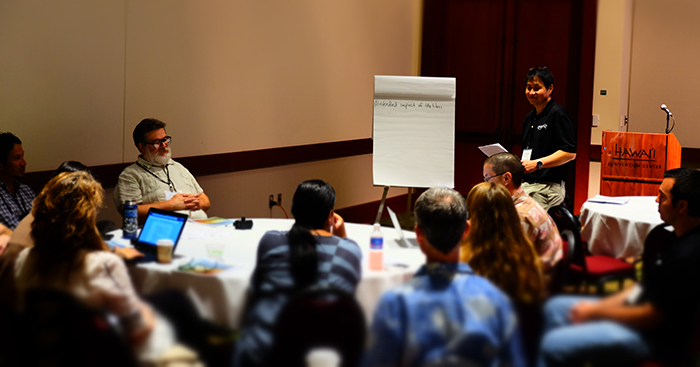
PRiMO session in progress

Sign Up for PRiMO Notifications!

Join Our Email List