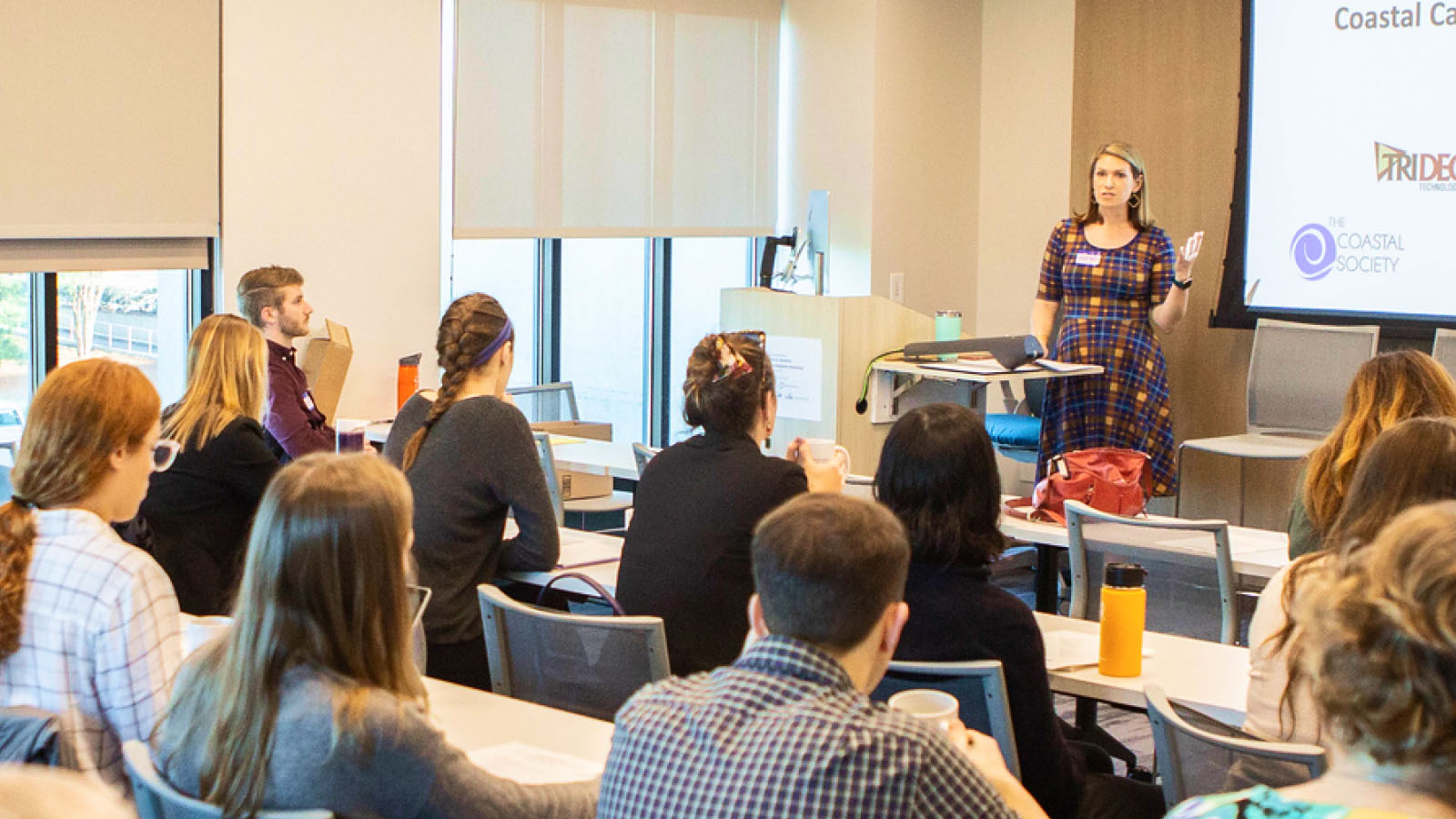
The Takeaway: Discover how Washington State equips practitioners to educate the public and private sector about ecologically sound shoreline protection.
Overview
Washington State is currently softening its shorelines from previous bulkhead constructions, and a diverse team of practitioners is educating planners, contractors, and consultants on the benefits. Learn how these experts from the public and private sectors created a flexible course schedule that introduces their target audiences to soft-shore stabilization techniques.

Lessons Learned
- Understand your role as an educator. It is essential to know how and why educational materials, particularly those focused on working professionals, are used. The Alternatives to Bulkheads Training was not designed to be the “be-all end-all” training on softening shorelines; that is not the role that the educators play. Rather, the training is a supplement to understanding the nature of coastal work, which often requires continual learning, locally specific knowledge, and adjustments to previous understanding of coastal and management processes.
- The success of the course relies on the interdisciplinary team. These trainings could not have been completed without multiple people and organizations with varying expertise. Having adult educators work with private-sector professionals, for example, resulted in a well-designed training that will stand the test of time and meaningfully support the education of coastal professionals. A strong advisory committee enabled the team to persevere, even through staff changes throughout the project.
- Constraints and barriers can be frustrating, but often result in better outcomes. Needing to be creative because of COVID caused additional delays, but ultimately resulted in a better training program. The increased demand to create virtual offerings during the pandemic led to a course that is better suited for busy schedules and flexible for learners. Without this constraint, the course would likely have followed the previous model used by the creators and would not have evolved.
- Be creative in how you tackle audience needs. While the team knew that some segments of the audience wanted a certification program, they had to get creative and meet in the middle by offering continuing education credits. Building a certified program takes a lot of capacity that the training team didn’t have. These incentives consistently kept classes full.
The Process
Needs Assessment
Local permitting codes in Washington State have been changing over the past several decades, and there is a growing interest in moving away from bulkheads and the other hardened techniques used in the past to protect eroding shorelines. Planners, consultants, and contractors are interested in learning how to use soft shoreline protection techniques. For Washington State, these techniques entail using natural materials such as gravel, sand, logs, and root masses in designs that have some degree of flexibility, mimicking natural processes. These techniques can help provide protection to property owners while improving the ecological health of the marine shoreline, and often go by many names, including nature-based solutions or natural infrastructure. However, there has been a gap in educational opportunities to help people understand shoreline health and the stabilization methods that meet multiple goals and still protect local communities.

Nicole Faghin, a former coastal management specialist with the Washington Sea Grant program, felt it was critical to fill these educational gaps. Nicole partnered with Cathy Angell, the former Coastal Training Program coordinator at Padilla Bay National Estuarine Research Reserve, to conduct a needs assessment and form an advisory committee. In addition to Nicole and Cathy, the advisory committee comprised public sector representatives from state agencies, county and municipal governments, NGOs, and local contractor and consulting firms.

The advisory committee assessed needs through a market analysis of other training opportunities, interviews with contractors, and surveys of planners and consultants conducted by different groups in the region on similar topics. This committee drove the training development, along with instructors from private companies and government agencies to help cover permitting and technical expertise.
One member of the team later stated that “including the private sector in the development of the training is one reason our training stands out from others."
Training Development
To help inform the training design and delivery, the advisory committee looked at examples from the Michigan Shoreline Partnership, Washington Sea Grant, Washington Department of Fish & Wildlife, Washington Department of Ecology, the British Columbia Institute of Technology, and NOAA’s Office for Coastal Management, along with their own personal experiences.
They also incorporated adult-learning principles into the curriculum design. Cathy Angell was instrumental in providing this knowledge since she developed many trainings over her 30-year career. Adult learning integrates practical application and opportunities to problem-solve. Cathy’s knowledge of adult-learning principles ensured the training was accessible and consistent with what coastal professionals needed to do their jobs.


The team also had to move the trainings to a virtual format due to the global pandemic. These adjustments included using a digital platform for self-paced learning, offering virtual classes on Zoom, and providing hybrid courses with a virtual lecture paired with field components. This type of framework offered more flexibility to learners and helped ensure the learning mode was tailored to the content. Self-paced courses allowed learners to complete introductory modules in batches when they had the time, while virtual courses and in-person site visits were used when most appropriate for the material.
Based on the needs assessment, the advisory committee came up with several topics as potential trainings. A combination of surveys and interviews with potential training audiences, including coastal professionals and contractors, was conducted to help focus the core topics that would be covered, along with feedback from the advisory committee. These findings led to six modules.
- General concepts related to shorelines and stabilization.
- Overview of local, state, and federal permit requirements.
- How to address site assessments for design/construction.
- Demonstration of need and risk assessment and alternatives analysis.
- Techniques for erosion control, including construction materials and maintenance and incentive programs for shoreline homeowners.
- Sea level rise issues.
Read the Marine Alternative Shoreline Training: Needs Assessment Report to learn more about the needs assessment process and outcomes.

Pilot Trainings
Initial course pilots included the first two modules: general concepts and permitting requirements. Through listservs, primarily through the Padilla Bay community, and sharing the learning opportunity with other networks, including a local shoreline and coastal planners group, the team was able to form a solid pilot group. The coursework resulted in a series of asynchronous (self-paced) courses, synchronous (learning together with a trainer) virtual classes, and in-person field site visits. The first module (a self-paced training) was designed to be completed before the others, and most of the participants did so, with an 87.5-percent completion rate. Post-training surveys showed support for more of these types of learning opportunities in order to accommodate people's busy schedules. The team was able to develop and release all remaining courses in the training program in two phases over two years.


During this time, Nicole and Cathy left their positions, but the partnership between Washington Sea Grant and the Coastal Training Program remained strong. Backfilling those roles allowed for two new team members: Sydney Fishman was hired as the coastal management specialist with Washington Sea Grant, and Sara Brostrom was hired as the Coastal Training Program coordinator for Padilla Bay Reserve. Cathy and Nicole continued to be involved through the completion of the final training as lead trainers and advisors.
Following the pilot courses and completion of the first entire training catalog, a few adjustments were made for the second implementation of the full series. The first was releasing the dates for the complete training course list all at once, rather than in batches, making it much easier for participants to plan to attend the dates they are interested in. These batch releases also included running through the entire course in less time.
The team plans to maintain the training by having different subject matter experts cover different training topics. Previous recordings, pre-made presentations, and agendas enable others to step in if the facilitators leave their roles or last-minute unavailability disrupts planned training days. Also, having a central training manager, Sara, helps with management needs and future longevity.
Additionally, because the needs assessment was funded by the Habitat Strategic Initiative through the Environmental Protection Agency’s (EPA’s) National Estuary Program, the EPA uses this course as an excellent example of implementing funds where the initiative's and individuals' needs are met. Working intentionally through existing partnerships and structures means longevity was built into the course development from the beginning.
Next Steps
The Padilla Bay Reserve Coastal Training Program consistently adapts its programming to meet the needs of the audience. A needs assessment conducted in 2025 confirmed a high level of interest in the six-part training series, which the program will now offer in 2026. Additionally, updated regulations on shoreline stabilization and sea level rise planning, which are forthcoming within the state, are also likely to change the course content. Updating the training with relevant and local examples will also be essential to the training's evolution. While the trainings will continue to evolve, they will remain a significant fixture for the state in softening shorelines and leading coastal practitioners toward a more resilient future.
Contributors
- City of Bainbridge Island, Washington
- Blue Coast Engineering
- Cathy Angell Communications
- Friends of the San Juans
- Herrera
- Island County, Washington
- Jefferson County, Washington
- King Conservation District
- Kitsap County, Washington
- Northwest Straits Foundation
- Pierce County, Washington
- Qwg Applied Geology
- San Juan County, Washington
- Saratoga Environmental
- Sealevel Bulkhead Builders
- Sound Native Plants
- State of Washington
- Stewardship Centre for British Columbia
- Thurston Conservation District
- Waterfront Construction
- The Watershed Company
- Washington Department of Fish and Wildlife